
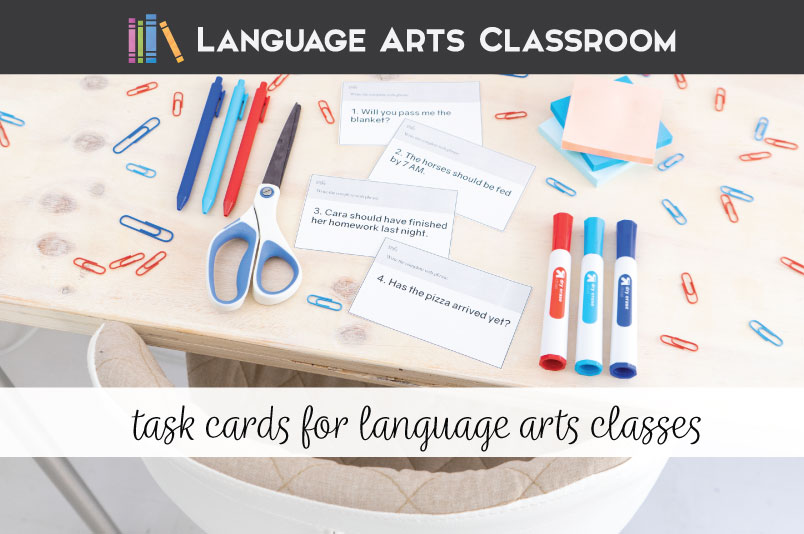
Use task cards in the language arts classroom? They are my go-to tool for practice of important skills.
Older students enjoy movement and a switch of pace with activities. Task cards are simple tools that provide great opportunities in ELA class. They are alternatives to worksheets and can provide entryways for larger discussions.
I’ve used these handy tools for years, and whenever I publicly speak about task cards, teachers have questions, so I’ve included tips in this post.
How can I get started with task cards in the language arts classroom?
Simple! Take whatever topic you are studying, add a “task” to a task card—print and cut! My favorite way to save time is to laminate my task cards for long-term use. Then, we can practice as a class, or students can practice individually. The longevity saves me time.
Below are benefits of task cards.
Personalized learning.
Prepping task cards in advance can be timely, but once they are printed, cut, and laminated, you are ready for many years. I often hang each task card on the wall or board with a piece of tape. Students grab one as they enter the room. Then, I ask them to complete the task independently. Finally, I divide them into groups (by similar tasks written on the cards), and they take turns discussing their answers. I can circulate and correct misconceptions, praise good thinking, and support bigger conclusions.
Personalized learning is mandatory for reaching different levels of learning. Certain tools allow for teachers to share information in discreet ways!
Discussion opportunities.
Certain areas of class (like literature) demand conversations that lead to critical thinking. Getting there, however, takes some planning, a bit of breaking the ice.
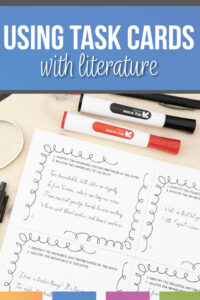
With literature task cards, I often:
- Distribute the cards to students, like with these Romeo and Juliet ones.
- Pair students to discuss their answers.
- Divide students into larger groups to present to each other (a rehearsal of sorts).
- Have each group present to the class.
If we are working on a larger project, like a literary analysis essay, task cards are an easy entry point.
Multiple practice opportunities.
Concepts like grammar and punctuation will require multiple attempts at understanding the rules and nuances. Sometimes, ELA teachers feel like they are teaching grammar wrong to which I say. . .
it is tough!
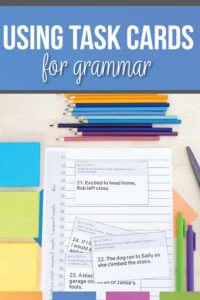
Using a variety of learning approaches is absolutely the right track. Consider practice with the eight parts of speech. Older students might think that elementary students are the only ones who study parts of speech. We know, however, that understanding vocabulary and using works in new contexts requires knowing the parts of speech.
Plus, grammar is not the only concept in language arts classes that needs plenty of review. Domain-specific vocabulary connected to literature, writing, and informational texts often takes repetition as well.
Differentiated learning.
I don’t think that differentiation is the answer to every problem in education, and I acknowledge the struggle of differentiating without adequate time to prepare.
However, task cards allow me to differentiate quickly.
Increased ownership of the learning process.
The more I explain metacognition with students, the better the results. When students realize that repetition helps in the learning process and that people can study in all sorts of ways (like with task cards), the more involved they are in studying.
Task cards in the language arts classroom can provide movement, scaffolding opportunities, and fun. You can use task cards across your lessons to discuss important language arts concepts, to highlight lesser known details, and to layer lessons.
Where can I find free English language arts task cards online?
Since test prep can be long and dull, I use task cards to make the material more engaging. You can try this set of task cards for free.
Help students engage in the content by showing them different types of learning tools for content they might not love (like test prep).
Are there any creative games or activities that use task cards in ELA?
An engaging way to use task cards is to create a scoot activity. Arrange a stack of cards in a line around the classroom, create small groups, set a time limit, and have students “scoot” across the row of cards.