

Tackle parallel structure with high school students in their writing and beyond.
We ELA teachers have lots of language standards. I have broken them down in previous posts covering clauses, phrases, and verb voice.
Many times, the first time through a lesson on a grammatical concept can be rough for teachers and their classes. Anticipating where they might have questions and thinking of examples quickly takes practice. This post should help.
How can I tackle parallel structure with high school students?
The best way to teach a grammatical structures is to apply the same structure we use across all of ELA. Provide direct instruction, practice the concept, and give feedback. Give definitions and examples of parallel structure, and then ask students to write sentences.
Where will students need to know about parallel structure?
Students typically encounter parallelism in two ways: with writing errors and with beautiful emphasis in poetry, writing, and speeches. That combination means that students should experience examples and prevent errors in their creations.
Are there engaging classroom activities or worksheets to practice parallel structure with high school students?
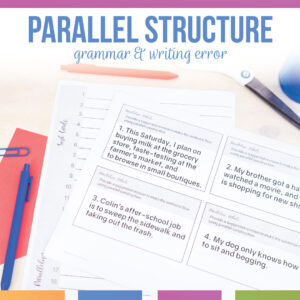
My activity download contains task cards, a presentation, and an assessment regarding parallel form. If you need additional practice, any standardized test prep will have examples in the English portion.

Standardized testing—the English portion.
First, yes, parallelism is in standardized testing. The expectation is that upon admission to college, students understand the complexity of language. Therefore, parallel structure is probably on the English portion of any college entrance exam.
Still, students uninterested in formal testing should understand language use. Readability and strong grammatical form is important for communication.
Writing for clarity.
When we work with writing, I present parallelism as a tool to improve communication. Humans look for consistency and patterns as they read. When we write, we can apply that fact to our structure and make a cadence that in turn makes our material memorable.
Public speaking and parallelism.
Speaking is another opportunity for students to implement best practices regarding parallelism.
My favorite speech to use as a mentor text regarding parallelism is FDR’s Day of Infamy speech. Sometimes, I will ask students to research a famous speech to see if it has examples of parallelism. Sure enough, they can often find samples.
How can young writers correct parallel structure errors?
Once classes can identify parallel structure and understand the concept, they are ready to identify problems.
The best trick concerning errors is to find each conjunction and to look on both sides of that conjunction. For example, in lists, all the nouns should be the same: George ate both apples and raspberries. Those sort of examples provide a simple review before moving to more difficult examples.
Can you give simple examples of parallel structure that high school students can easily understand?
Single words (like above) are rarely the true issues with parallelism. Complex and longer sentences have more chances for errors. Consider verb voice: Jacqueline and I awaited the test results, we were shocked by them, and we soon went home.
That sentence has three independent clauses. The first and third are in active voice, but the second is in passive voice. All of them should be in active voice.
Where can I find free resources or handouts to teach parallel structure to teenagers?
Check if your school or public library has standardized test prep books. Those prep books contain detailed answers. After a bit of practice, you and your teen will spot issues with parallelism.
Can you explain the difference between parallel structure and other grammar concepts for high schoolers?
Honestly, many concepts (like voice tense) are part of parallelism issues. When you review other concepts, you can probably include explanations about parallelism as well.