
Poetry and creative writing: engagement, SEL, and classroom management for high school ELA.
A tall order for simple poetry and creative writing activities? Yes, fun connected to content makes life easier for students and teachers alike.
The more I experiment in building classes’ writing skills, the more I find that when young writers experience personal growth, the more invested they become in class.
No matter your creative process for lesson planning, here are ideas for experimenting.
What are simple creative writing exercises for poets?
If you need basic, simple creative writing exercises, start by analyzing some famous poems with graphic organizers. Have your readers analyze the vivid imagery, rhyme, and punctuation of different types of poems. Note what interests them, and then ask them to create a poem using those features.

How is poetry different from other types of creative writing?
First, any type of written assignment will have best practices, theories, and possible mentors. In that way, they are similar.
The activities with poetry might be freeing in a way the those labeled narrative or creative nonfiction might not be. For instance, blackout poetry and shape poetry have a freedom that lends itself to exploration.
What supplies do I need for teaching poetry and creative writing?
The beauty of combining these concepts is that you will need very few supplies. You can spark interest with your students through small-group activities and well-placed reflection components. As someone who saw students come alive in a semester-long creative writing course, I encourage overlapping poetry with writing.
Here are ideas.

Why creativity matters.
Creativity runs alongside ELA. Literature is an art form, and language is a powerful tool in everyday life. Every slice of our curriculum could be considered creative in some way.
So, to recognize the world of ELA and to pull in different styles of learners, we should showcase our creative components.
How we make the time.
Incorporating poetry and creative writing might start slowly, but with experimentation, you will find ways. For instance, when I teach verbals and verbal phrases, we study them with “The Raven” by Poe. Anytime we can show students that grammar is part of what we read, we are teaching creatively.
Of course, everyone will experience benefits when poetry and creative writing overlap. Different approaches lend themselves to critical thinking.
Benefits of these creative endeavors.
SEL can be a buzzword, but honestly, best practices include looking at the entire human. Poetry and creative writing do just that.
Plus, innovative approaches to learning often overlap and touch the personal lives of students.
Take for example the SEL commitment to promoting self-awareness. Poets ask readers to study language, to examine word choice, to feel emotions through the paper. What do readers notice? What are the aware of? How do other relate? In what way can components of a poem relate to the reader’s life?
Connect to authentic audiences.
The “publication” step of the writing process is a sticking point for many teachers. Do not overthink publishing. Showcase student work in the halls or digitally around school. Combine files into a PDF, compress the PDF, and share with caregivers.
As another option, several colleges offer workshops and opportunities for high school students, like the Iowa State Workshop. (I have never had students attend one, but please contact me if you have any more recommendations!)
Teach beautiful English prose.
From Shakespeare to stunning Harlem Renaissance poets, English class showcases the inspiration of talented artists—important mentor texts. These examples serve as mentor texts. They also lead to easy poetry prompts.
The practice of poetry takes time. Give students a choice in poems so they can find one that resonates. Then, ask them to choose a word or message that could lead to their own poem. (I have a list of poems that work well for figurative language analysis.)
They might find comfort in using the same format as their mentor writers, maybe the same rhyme scheme. Encourage experimentation.
Don’t seek perfection.
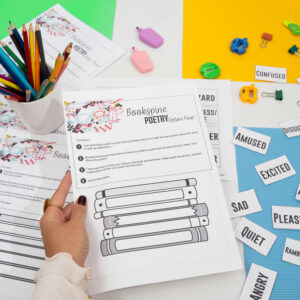
The freedom to be human, to wonder, and to explore: all important ELA concepts. With activities like book spine poetry, we can be creative with books, any books!
Much like the rest of life, creative problem solving will be messy. When we work on a challenging activity like book spine poetry, we are modeling and supporting our students for life.
In my own experience, allowing classes to experience storytelling in different types of poetry, writing prompts, and overall creative thinking leads to learning in surprising ways. Instead of looking at these tools as simply fun experiences, acknowledge they build relationships, provide SEL tools for classes, and give insight into the beauty that is a language arts class.
Finally, book spine poetry serves as both a poetry analysis and creative writing activity—an important goal for ELA teachers.
Decorate with blackout poetry.
If you’ve poked around on my blog, you know I am not a decorative, Pinterest-y type of teacher. My walls are bare until my students decorate them with their work.
One of the best poetry activities for high school involves up-cycling old books. Keep a pile of books that are falling apart, or ask your librarian or online friends for donations.
Distribute pages to students and provide a few guidelines. Students should read the page and find an approach to take with their poem from the words there. They only need ten or so words. Then, they should mark out (the “blackout” part) words that will not align with their new poem.
Mistake? Not happy with the result? Try again! The only tools you need are torn pages and a marker.
Lots of guidelines? For me, over-directing students resulted in less investment in what they were creating with blackout poetry. I want my high school ELA poets to have freedom to create.
After all, that is what we are doing, right? Connecting all aspects of language arts in beautiful, messy, and new ways.