
Meet the teacher night, sometimes called back to school night or open house, is one of the first chances a high school English teacher gets to connect with students’ families. Whether you’re presenting to a packed auditorium or running freshmen orientation for incoming students, a little preparation turns a stressful evening into real relationship-building.
If you need a pep talk for your language arts meet the teacher night, keep scrolling.
How to Calm Your Nerves Before Meet the Teacher Night
The best way to overcome nerves for speaking is preparation. Know your goals, and plan out your night. I don’t have all the answers, but after my last meet the teacher night for language arts, I wrote down my ideas below.

Prep Your Meet the Teacher Night Presentation
Don’t head into meet the teacher night without a map to guide you. The teacher presentation should give concrete information:
- School activities coming up—perhaps a field trip.
- Email address and phone number.
- Hours. Be sure to include when you leave school.
- Supply lists.
- Overview of the class.
- Reading requirements.
Some teachers share their Amazon wishlists, but that is a personal preference. I’m not comfortable doing that, but again, make the presentation yours!
You can also establish boundaries at your meet the teacher night for language arts. Will you take about 24 hours during the work week to return emails? Do you accept late work?
I spend most of my time explaining why we read in class together and why students should read at home. The beginning of the year is the time to explain to students and their adults about the importance of reading. I establish expectations for reading and share places to find books (local library, school media center, my classroom library).

Introduce Yourself to Students’ Families
Students spend hours each year with their teachers. Naturally, parents would like to know a bit about them.
But! In no way does that mean you should share anything you are uncomfortable in doing. For instance, I show a picture of my family, but I can imagine several reasons why other teachers would not. I also share a bit of information about my hobbies and family life like hiking and traveling. Stay in your comfort zone, and only spend a little bit of time on your personal life.
I also share where I went to college, why I became an English teacher, and what I enjoy about teaching. Those topics are safely inside my comfort zone. As a new teacher, I probably overshared. At my current meet the teacher night for language arts. I also showed my publications, but I was confident in doing so.
Be sure to follow your gut, and only share what you’d like!

Explain Your Classroom’s Routines and Big Picture
School is difficult for many people and unfortunately, in my experience, part of that is because systems make no sense to people outside school walls.
For instance, why do I start my classes with spiral grammar? After explaining a few of my routines and processes, I share that language standards are tough. When students tackle pieces over time, the topics are less intimidating.
As school starts, adults are overwhelmed by school supplies, class schedules, and volunteer opportunities. (As a parent who attends meet the teacher nights, the amount of important information can be overwhelming!) To put forth a great first impression, speak with confidence and reassurance. In my presentations, I share research to support my methods. Afterwards, parents receive an email with a link to that presentation so that they can review my information. If parents visit six or eight teachers, they have lots of information to forget.
Of course, you should not over-explain yourself. Simply give an example from your classroom that demonstrates you’ve thought through the school year. Model one component of your class so that adults recognize you have control.

Give Feedback Without Shaming Students or Families
As a parent, I expect professionals to give me authentic and helpful feedback. Some examples:
- A coach tells me that my child is having trouble completing certain task. That might start a discussion if there is a confidence issue, a misunderstanding, or a physical pain.
- A pediatrician tells me that my child needs to eat more protein or veggies. That might spur me to look at our family diet or food packed in lunches.
- A teacher tells me that my child should work on vocabulary. That might encourage me to look at choice books at home and to find a new variety.
All of those instances have happened, and all three times, the professional was kind, courteous, and helpful. I believed they had my child’s best interest. They did not shame me or my husband.
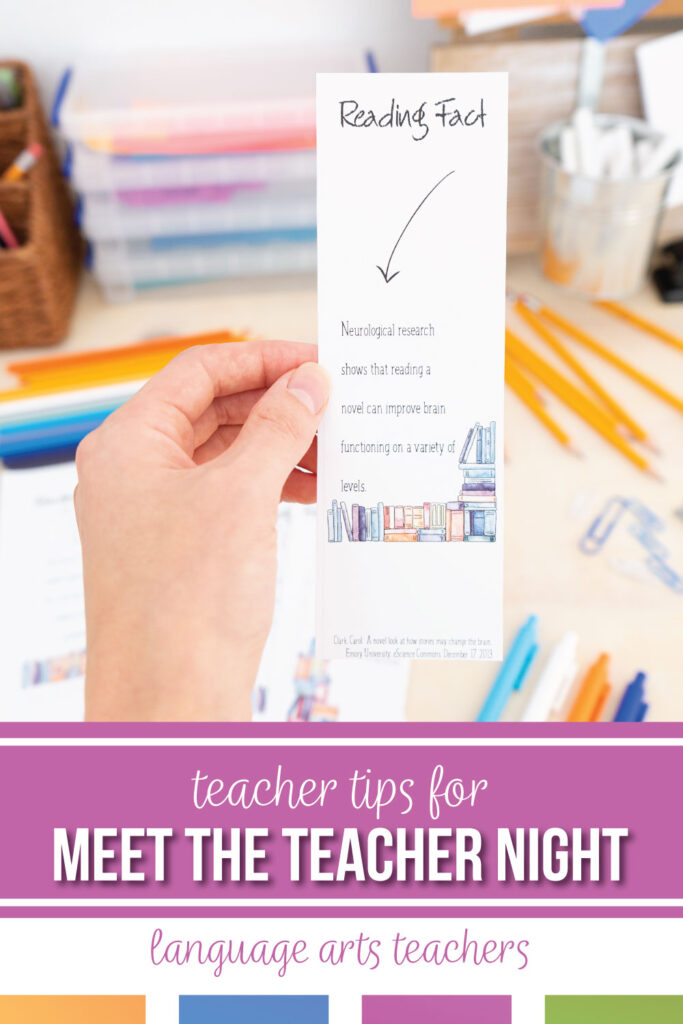
Similarly, my students should read. Endless research shows that when students have books at their home and when they read outside of school, they reap benefits. I decorate my classroom with facts about reading and provide bookmarks for students to take home.
More importantly, I share ways that adults can get books into their home. One, I offer up my classroom library. Any student can borrow books to take home. Two, I explain about the town’s public library and school library. Three, I show them my state’s library services.
Basically, parents leave equipped with different places to find books inexpensively or free. Your specific state and community might have different options. At your meet the teacher night for language arts, give the adults in your students’ lives value.
Finally, if your school has a curriculum night or other information parents would benefit from, consider adding your school’s welcome packet or program to a table in your room. Be sure that your information does not overlap with an event like freshmen orientation. Parents should not have to sit through the same information twice.

Stay Connected All Year: Newsletters, Instagram, and More
A nice touch is to explain how you plan to connect with adults. I send out notifications through our grading system about important due dates and success. Once, my Creative Writing class created a poetry book. I assembled and compressed the PDF and sent it to everyone in the class.
One of my personal kiddos had a teacher who posted on a private Instagram account. The parents saw cute videos of scavenger hunts, station work, and daily events. Another teacher sent out a monthly teacher letter from the classroom, music, and art teachers. Finally, some schools have websites that have blog posts and videos about classroom events. Tell adults what to expect.
When adults see that you are invested in their child, they are more likely to work with you. You can leave for the night knowing you planted seeds about reading outside of school, connecting with parents, and how you plan to reach out to them.
Your goal is not only teaching children but partnering with parents to help their children be successful.
The adults, the parents and guardians, want to know that you see their children as important humans.
Which. . . is probably the best tip for meet the teacher night. We are all humans, the teachers and the guardians and the students. Be yourself, show everyone that you care and want to teach, and build connections for a great school year.
What About Freshmen Orientation?
I’ve seen freshmen orientation incoming freshmen handled differently across schools. Some are at the end of eighth grade, and others are right before the start of freshman year.
No matter when you need to chat with caregivers and students, you’ll want to be prepared to help with the transition to high school. Since this event will be the first time meeting new people who will be around for four years, you’ll want to bring clarity and answers.
Set yourself up for success with classroom management, caregiver and family relationships, and a strong start to that first year by considering what everyone needs to know for a successful freshmen experience.

Editable email, templates, checklist, slideshow: the bundle.
Yes, I have assembled tools for that important open house or school night where teachers meet everyone.
No, it does not include anything cutesy like icebreakers or large graphics.
The Meet the Teacher Night Bundle has editable tools like research-supported information to share, contact information, editable letter, and other tools to get you started for the new school year.
After teaching for over twenty years, this approach meets the professional goals required of a meet the teacher night for language arts, and it encourages relationship-building at the start of a new school year.