
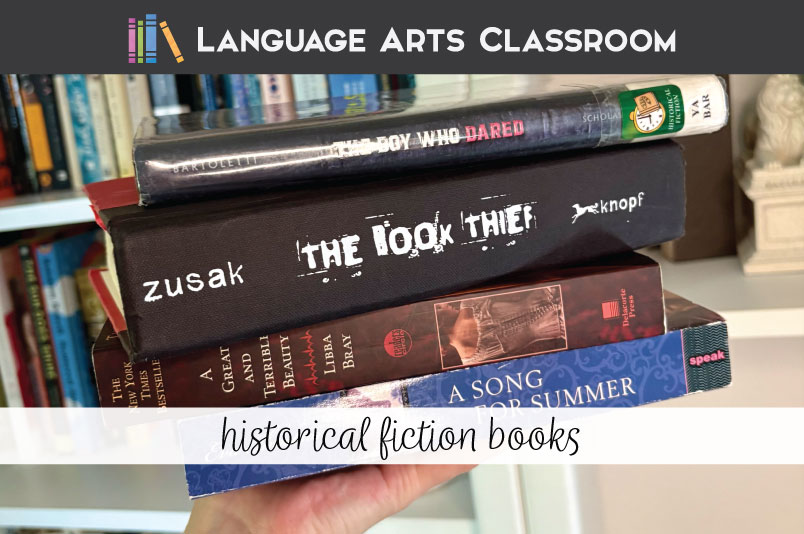
Teaching historical fiction allows for reading and writing opportunities.
Readers love historical fiction. Students devour my classroom library selection of this genre. Sometimes, a student will read every historical fiction book in my room.
Since the popularity is on the rise, let’s harness its power.
How can teaching historical fiction fit into my classroom?
Never underestimate the power of putting books into students’ hands. Bring in historical fiction novels to boost lessons. Introduce young writers to the narrative structure, history, and language in these books.
Engage students with historical context—to benefit other literature lessons and expand knowledge.
Read historical fiction books.
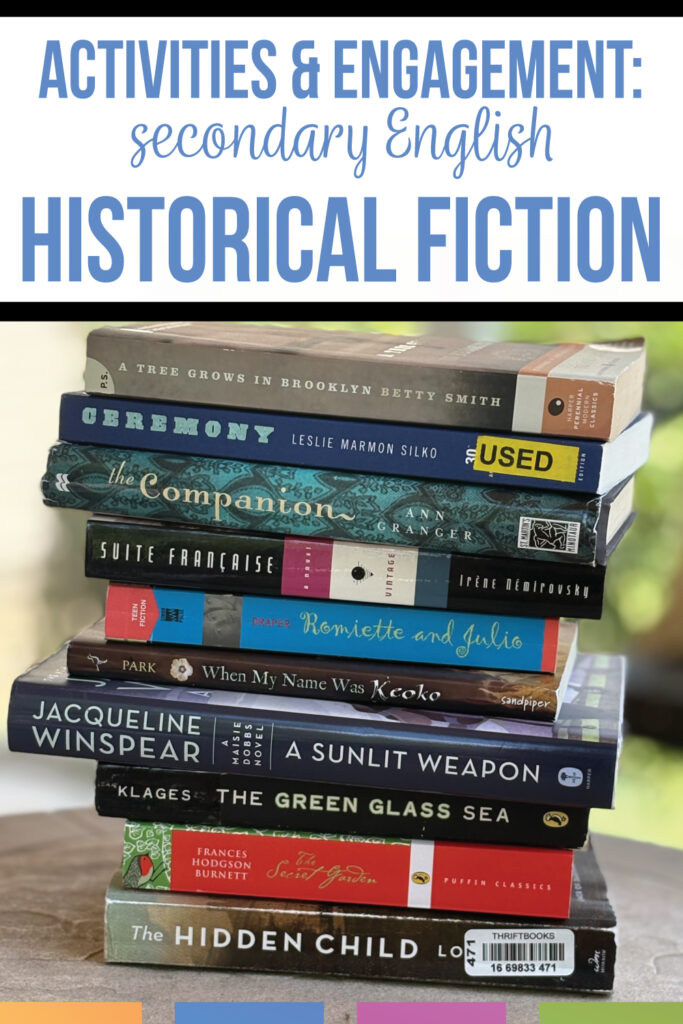
Since this genre is so popular, I purposefully incorporate it into First Chapter Friday. Options include:
Those are suggestions, and you probably have more in your classroom library. (All of those are affiliate links, btw!) If you don’t implement First Chapter Friday into your classroom, you can also book-talk these.
Write a historical fiction piece.
The beauty of teaching historical fiction? We can both read and write with this genre. Starting the writing activity off with pictures provides a transition into thinking of historical elements. Then, conduct research for this realistic fiction activity.
Next, consider with students what sort of pieces are necessary for a narrative: setting, dialogue, and conflict are a few. All of these require accuracy for a historical fiction piece, a fact that requires critical thinking. Walk through ethical research with classes.
Finally, you might narrow the focus for young writers as this genre can be difficult. Consider focusing on the main character and their point of view (for example).

Use objects: pictures, keys, small objects.
If you’ve been around my blog, you know that I love using objects for inspiration to introduce material. When teaching historical fiction, you can bring in objects from home, thrift stores, or a school’s storage closet.
My favorite place to find inspiration is garage sales or thrift stores. Small trinkets often sell for a quarter.
What stories could these objects hold? What new information can we learn about older technology or objects?
Add to literature circles.
A great way for studying historical events and for building background knowledge is to allow students to choose the historical setting they’d like a deeper understanding of, and let them choose a book.
With discussions, you can discuss author’s use and narrator methods, hopefully leading to empathy.
Another option for lit circles is to choose a specific time period (as short or as large as you’d like) and find books to match the time period. Book clubs also are an option.
What if I don’t have a historical fiction unit?
The only solid “historical fiction unit” that I have done centered on the Holocaust with our main source being The Book Thief.
You can use the ideas in this blog post as much or as little as your classroom allows. Provide an overview of the genre, provide factual events from a book’s setting, and witness the power of historical fiction.
Are you not teaching historical fiction? What about a memoir or coming-of-age novel? I have ideas for those genres too.